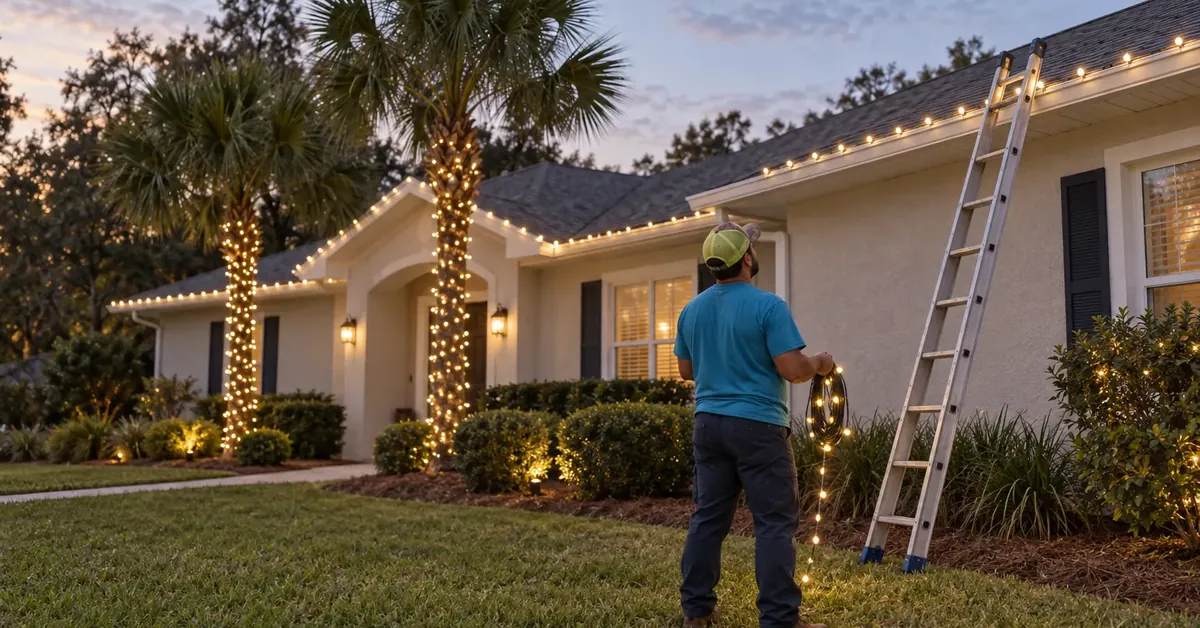
Professional Christmas light installation cost depends mostly on how much roofline, tree, and shrub area gets lit, how tall and hard to reach the home is, what lights are used, and whether takedown and storage are included. Compare quotes by scope, not total, because two quotes with the same bottom line can cover very different work.
What does a professional holiday lighting quote usually include?
A full-service quote usually covers a design walk-through, the lights and clips, installation labor, and a plan for removing everything in January. Some also include repairs when a strand fails mid-season, and some include storage. Others only cover installation, which is why two totals can look far apart.
Ask for the quote itemized. You want to see roofline, trees, shrubs, and extras like wreaths or pool cage edges listed separately, along with takedown and storage. A single lump sum makes it hard to tell what you are actually paying for.
What drives the cost of Christmas light installation?
Labor and materials both move the price, and the biggest driver is simply how much of the property gets lit. The table below shows the main factors and how each one tends to change a quote.
| Factor | What changes | Effect on the quote |
|---|---|---|
| Length of roofline | Feet of eaves, peaks, and gables | More footage means more lights and labor |
| Home height and roof type | One story or two, pitch, tile or shingle | Taller or steeper takes more time and equipment |
| Trees and palms | Number, size, trunks or canopy | Large trees take the most time |
| Shrubs and beds | Net lights or strands, bed size | Quick coverage, moderate add-on |
| Light type | Retail or commercial grade, color, bulb style | Sturdier lights usually cost more upfront |
| Takedown and storage | Included or priced separately | Adds a line item, saves your time |
| Extras | Wreaths, bows, timers, pool cage edges | Each item adds material and labor |
Footage and height set the baseline, and everything else adds to it. Compare quotes on the same factors rather than on the bottom line alone.
Access matters too. Gated entries, steep yards, pool cages, and tight landscaping slow a crew down. Installers also need working outdoor outlets, and adding timers or fixing power access can show up as extra items.
How do roofline, trees, and shrubs change the scope and price?
Roofline
The roofline is usually the base of the job. Installers measure the eaves, peaks, and gables, then price by length and difficulty. A single-story home with a simple eave goes fast. A two-story home with several gables, or a steep roof, takes more time, more safety setup, and more lights.
Trees and palms
Trees are where quotes vary most. Wrapping a palm trunk is straightforward. Lighting the branches of a mature live oak, often draped in Spanish moss across North Central Florida, takes far more strands and time, and the height may call for a lift. Ask whether the quote wraps trunks only or lights the canopy.
Shrubs and beds
Shrubs are usually the quickest area to cover. Net lights go on fast over dense hedges, while strands work better on open, irregular plantings. Trimmed shrubs also light more evenly, so cutting back overgrown plants before installation day can save time.
Is it cheaper to buy lights yourself or use commercial-grade lights from an installer?
Buying retail lights costs less on day one, but it is not always cheaper over a few seasons. Retail strands often fail partway through the season, and you are the one on the ladder replacing them. Many installers use commercial-grade lights built for repeated outdoor use. Ask what grade is being used.
Count your own time and risk as well. Hanging lights along a second-story roofline means ladders and slick shingles, and falls are a real hazard. Then comes the testing, sorting, and storing. A DIY budget should include replacement strands, clips, cords, outdoor timers, and storage bins, not just the lights.
Some installers supply the lights as part of the service, and others install lights you provide. The first keeps the work under one price. The second may limit what the installer will guarantee about performance. Get the answer in writing.
How do takedown and storage affect the total cost?
Takedown is easy to forget when comparing quotes. Some installers include it in the price, others charge it separately, and a few leave it to you. Removing lights from a roof and trees takes a good deal of effort, so a quote without it is not comparable to one with it.
Storage matters in Florida. Heat and humidity in an attic or garage are hard on cords and sockets, and tangled strands are a common reason homeowners buy new lights each year. Having the installer store them removes the hassle, though it may add to the price.
We offer holiday lighting with installation, takedown, and storage, so all three can sit on one quote.
How do you compare holiday lighting quotes side by side?
Lay the quotes next to each other and check that they cover the same work. Use this list:
- Same areas lit: roofline, trees, shrubs, and extras
- Same light type, bulb style, and color
- Takedown included or separate, with a rough date
- Storage included or separate
- Repairs during the season, and how quickly they happen
- Deposit, payment timing, and cancellation terms
- Who supplies the lights and who owns them after the season
Ask what information the installer needs to quote the property, including roofline, tree height, and access.
Book early. Demand for holiday lighting peaks in November, and installer calendars fill fast. Homes in an HOA should also check display rules and timing with the association, since these vary by community and city.
To talk through a quote for your own home, send a note through the contact page. There is no pressure, and the checklist above works with any installer you are considering.
Frequently Asked Questions
When should I book Christmas light installation in Florida?
Book in early November or sooner, since demand for holiday lighting peaks that month and schedules fill. Florida's mild fall weather means installs often happen from November into early December. Booking early also gives you time to compare quotes without rushing.
Do installers provide the lights or do I buy them?
It depends on the installer. Many full-service companies supply commercial-grade lights as part of the price, while others install lights you buy. Ask which approach the quote uses and who owns the lights afterward.
Is takedown included in the installation price?
Not always. Some quotes bundle takedown, and others list it as a separate charge. Check this line before comparing totals, since removal is a real part of the work.
How long do professionally installed lights stay up?
Most displays stay up through the holidays and come down in early January. The exact dates are set in your agreement, so confirm them when you book. Ask about repairs for any strands that fail while the display is up.
Can lights stay on a roof through Florida storms and rain?
Outdoor-rated lights are made to handle rain, and secure clips help them hold up in wind. Strong storms can still loosen or damage a display, so ask your installer how they handle repairs. Using protected outlets and secure connections also reduces problems.